
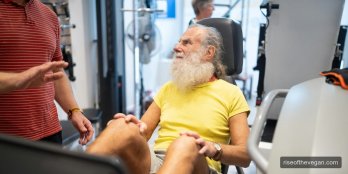
Photo: Centre for Ageing Better on Unsplash.
Vegan Diet Matches Meat-Eating Diet for Muscle Building in Older Adults, Trial Finds
University of Exeter researchers put 22 adults averaging 67 on a vegan or a meat-containing diet for a week while they did leg strength training, and the vegan diet supported muscle building just as well
Great news for anyone lifting weights in their sixties and beyond. A randomized trial from the University of Exeter finds that a vegan diet supports muscle building in older adults just as well as a diet that includes meat, even at the basic recommended level of protein.
The study, published online in The Journal of Nutrition on November 26, followed 22 healthy older adults, 12 men and 10 women with an average age of 67. After three days on their usual food, they were randomly assigned to eat either a vegan diet or an omnivorous diet, with 69% of its protein from animal foods, for seven days.
Both diets supplied exactly the same protein: 0.8 grams per kilogram of body weight a day (about 0.36 grams per pound), the recommended dietary allowance. For a 150-pound (68 kg) person, that's roughly 54 grams a day. That was about a quarter less protein than the volunteers usually ate.
During the week, each volunteer did three resistance exercise sessions with one leg, while the other leg rested. Using deuterated water (heavy water) as a tracer, the team measured how fast the muscle in each leg was making new protein for its muscle fibers, a process scientists call myofibrillar protein synthesis, or MyoPS.
The results are clear. In the exercised leg, muscle protein synthesis was 17% higher than during the volunteers' usual-diet days, and the trained leg built muscle protein 29% faster than the rested one. In the trained leg, the vegan group reached 1.88% of muscle protein renewed per day, against 1.74% for the meat eaters, a difference the researchers found was not statistically significant. Rates didn't differ between the diets in rested or exercised muscle at any point.
Thigh muscle thickness, measured by ultrasound, and the activity of 48 muscle genes didn't differ between the groups either. The authors conclude:
“A feasible vegan diet meeting the protein RDA, despite providing less protein than habitual intakes, supports daily MyoPS rates that do not differ from those supported by an isonitrogenous omnivorous diet in healthy older adults.”
Isonitrogenous means the two diets had the same amount of protein. Why does this matter? Muscle tends to fade with age, and as the researchers explain in the trial's registration, that loss is partly because aging muscle responds less to dietary protein and exercise. It's a common worry that plants can't keep up. This trial shows a well-planned vegan diet can, even at a modest protein intake.
It was a short trial in a small group, and it measured how fast muscle builds new protein over one week rather than gains in muscle size over months. But it fits a clear pattern from the same Exeter group, led by Professor Benjamin Wall and Dr. Alistair Monteyne: their earlier trial in older adults found equal muscle protein synthesis on a high-protein, mycoprotein-based vegan diet.
The same team showed that a vegan diet builds muscle just as well as meat in young adults over 10 weeks of training. Researchers at McMaster University found that pea protein builds muscle just as well as whey in older men, a Finnish study found that men who eat more plant protein have higher testosterone, and European research linked plant protein to better cardio fitness in teens.
Plants can build muscle at every age.
Subscribe!
Love this content?
Receive our awesome newsletter straight to your Inbox!
More in Health & Nutrition

Love this content?
Receive our awesome newsletter straight to your Inbox!


Comments