
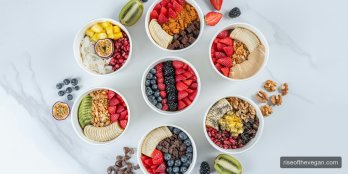
Photo: Eiliv Aceron on Unsplash.
Dairy Giant Danone's 42,000-Person Survey Finds Health and Easy Digestion Drive Plant-Based Milk Choices
92% of regular plant milk drinkers in the US, UK and Germany say it's easy to digest
Danone, one of the biggest dairy companies in the world, has published a survey of 42,000 adults in 14 countries, and it finds that people choose plant-based milks and yogurts for their health and for how they feel after eating them.
The research was run by market research firm Ipsos, funded by Danone, and published in the peer-reviewed journal Food Quality and Preference. Danone shared the findings in early November. About 3,000 adults aged 18 to 65 were surveyed in each of the US, Canada, Mexico, Japan and ten European countries.
More than half of respondents (55%) said they consume plant-based dairy alternatives. Asked why, 42% picked health, 35% taste, 34% naturalness and 32% digestive comfort, which Danone says consistently stood out across countries and consumer groups. Among those who chose digestion, 35% described plant-based products as "not heavy" and 27% pointed to them being "naturally lactose-free."
A second survey of about 2,500 regular plant milk drinkers in the US, UK and Germany found that 92% agree plant-based drinks are easy to digest and 88% call them light on the stomach. Oat is the favorite in Germany (76%) and the UK (50%), while almond leads in the US (58%). Plant-based yogurt alternatives (61%) and drinks (59%) are the most popular products overall.
Here's the interesting part. Danone's Essential Dairy and Plant-Based division, home of Activia, brought in €13.2 billion of the group's €27.3 billion sales in 2025, according to its full-year results. But Danone also owns plant-based leaders Alpro and Silk, which it gained by buying WhiteWave in 2017, and it calls itself "the global leader and pioneer in plant-based products." So it has a stake in these results. Even so, its plant-based team says the category is anything but a fringe one. Guillaume Millet, Vice President of Danone's plant-based division in Europe, told Nutrition Insight:
The research shows that the perception of plant-based as a niche category is a fallacy, with more than half of consumers including plant-based products in their diets, including drinks and yogurt alternatives.
Danone is careful to say what the study does not show: "This research captures perceptions. It does not measure clinical outcomes or physiological effects." The authors call the absence of lactose one of the most evident explanations, though they add that perceived digestibility is "unlikely to be attributable solely to lactose removal."
There are other good reasons to make the swap, too. A 2024 meta-analysis found that swapping cow's milk for soy milk lowers blood pressure and cholesterol, and an Oxford study of 38,700 farms showed that even the greenest dairy is beaten by plant foods on environmental impact.
This week we reported that a Dutch dairy farm that moved to soy yogurt won the first Plant Based Leadership Award. Earlier this year Oatly celebrated its first full year of profit and Caribou Coffee ditched its dairy-free milk surcharge, while plant milk is now in over a third of UK households. If you're not vegan yet, replacing cow milk might be the easiest place to start.
This article is for information only and is not medical advice; if you have digestive symptoms, talk to your doctor.
Plant milk isn't a niche anymore, and that's great news for everyone.
Subscribe!

Love this content?
Receive our awesome newsletter straight to your Inbox!
More articles you may enjoy












Love this content?
Receive our awesome newsletter straight to your Inbox!











Comments