
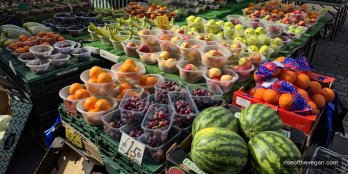
Photo: Acabashi via Wikimedia Commons, CC BY-SA 4.0, cropped. This adapted image is also licensed CC BY-SA 4.0.
Eating More Fruit and Vegetables Linked to 20% Lower Dementia Risk
Green leafy vegetables stood out, with 18% lower risk per daily serving
People who eat the most fruit and vegetables have a 20% lower risk of dementia, according to a meta-analysis of 222,108 people published in the American Journal of Clinical Nutrition on June 27.
Researchers at Zhejiang University School of Medicine in China first analyzed 18,339 adults aged 45 and over from three cohorts in the US and UK, the Health and Retirement Study, the Framingham Offspring Study and Whitehall II, followed for 7 to 13 years. Those in the top third for fruit and vegetables had a 26% lower dementia risk than those in the bottom third.
Each daily serving of green leafy vegetables was linked to an 18% lower risk, the only subgroup to stand out on its own. Combined with 13 earlier cohort studies, high fruit and vegetable intake was linked to 20% lower risk overall, vegetables to 13% lower and fruit to 10% lower, the paper reports.
The authors conclude: "Our study supports an inverse association of intake of vegetables and fruits with dementia risk."
Spinach, kale, chard, arugula, romaine and bok choy all count as leafy greens, so there are plenty of ways to add a serving.
It follows a study of 92,849 people linking plant-based eating to 12% lower dementia risk and a Harvard study linking a healthy plant-based diet to a 24% lower risk of cognitive decline.
Eat your greens, for your brain's sake.
Subscribe!

Love this content?
Receive our awesome newsletter straight to your Inbox!
More articles you may enjoy













Love this content?
Receive our awesome newsletter straight to your Inbox!













Comments