
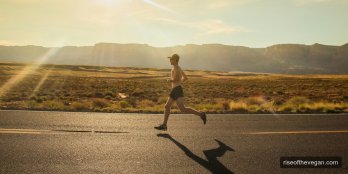
Photo: Isaac Wendland on Unsplash.
Runners Last Longer on the Treadmill After Three Weeks of Plant-Based Eating
A small Brazilian study of seven recreational runners also found body fat dropped while muscle held steady
Seven recreational runners in Brazil swapped their usual meat-inclusive diet for three weeks of plant-based meal kits, and at the end of it they lasted longer on a treadmill test to exhaustion than they had after three weeks of eating their normal food.
The study, published in Frontiers in Nutrition on November 2, comes from researchers at the Catholic University Dom Bosco in Campo Grande and the Catholic University of Brasília, with Tatiana Cantarella Sarmento as first author and Octávio Luiz Franco as corresponding author.
The volunteers were omnivorous men aged 25 to 45, recruited at sports events in Campo Grande. They had been running for more than two years and logged around 35km (22 miles) a week.
Each man was tested three times: at the start, after 21 days on his habitual omnivorous diet, and after 21 days on a plant-based diet. For the plant-based phase a local company delivered four meals a day to their homes, built from fruit, vegetables, whole grains, legumes, seeds, tofu and textured soy protein, and matched to the calories and macronutrients of each runner's usual diet. No meat, fish, eggs or dairy.
The treadmill test started at 6km/h (3.7mph) on a 1% incline and got 1km/h (0.6mph) faster every minute until the runner asked to stop. After the plant-based phase, time to exhaustion was significantly longer than after the omnivorous phase.
Body composition moved too. Median body fat fell from 13.3% to 9.1%, fat mass dropped by about 3.4kg (7.5lb) and weight by 3.9kg (8.6lb) compared with the omnivorous phase, with no significant change in fat-free mass. Fiber intake shot up by 64.5g, and (fair warning) so did reports of wind and bloating.
The authors are refreshingly upfront about what this can and can't show. With seven runners, a fixed order rather than a randomized one, no washout period and no practice run on the treadmill before the first test, they describe their results as hypothesis-generating. Treadmill time after the plant-based phase also wasn't significantly different from the very first baseline test. In their conclusion they write:
In this exploratory study, a 21-day PBD phase was associated with changes in body composition and selected exercise-related physiological responses in recreational men runners. Lower body fat and fat mass were observed following the PBD phase, with no statistically significant reduction in fat-free mass.
They also note that food left uneaten during the plant-based phase wasn't measured, so eating fewer calories may explain some of the fat loss.
So it's an early signal rather than proof. What it does add to is a growing pile of evidence that ditching meat won't slow you down. Earlier this year a randomized crossover trial of 36 recreational athletes at Stanford, Rutgers, Vanderbilt and the University of Reading found no statistically significant difference in how far runners ran or how much lifters lifted after four weeks on each diet.
Earlier research found vegan runners match meat-eaters for exercise capacity and vegan women outlasted meat eaters in an endurance test, and a meta-analysis found plant-based diets boost endurance without costing strength. Out on the roads, vegan ultrarunner Harvey Lewis ran 462 miles at Big's Backyard Ultra and Joe Camilleri completed all six World Marathon Majors at 76.
If you've been curious about running on plants, three weeks looks like a very reasonable experiment, and the benefits go well beyond the treadmill. In recent months the American College of Cardiology backed diets centered on minimally processed plant foods, one month on a vegan diet slowed markers of biological aging in a randomized trial, and heart attack survivors eating a healthy plant-based diet had a 26% lower risk of death.
A healthier heart, slower biological aging and a lighter footprint on the planet. Not a bad return on three weeks.
This article is for general information and is not medical advice. Talk to your doctor or a registered dietitian before making major changes to your diet or training.
Subscribe!

Love this content?
Receive our awesome newsletter straight to your Inbox!
More articles you may enjoy








Love this content?
Receive our awesome newsletter straight to your Inbox!







Comments