
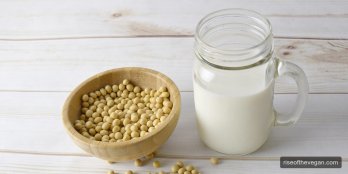
Photo: bigfatcat on Pixabay.
New York City Schools' Soy Milk Trial Wins Over Students and Expands to 12 Schools
Soy made up 35.6% of the milk students picked at five pilot schools, and students took 18.6% more milk overall where before-and-after data exist
New York City public schools put organic soy milk on the lunch line at five schools this spring, right next to the regular milk, and students took to it. Soy made up 35.6% of all the milk students picked, and the city is now expanding the pilot to 12 schools this fall.
The pilot started in May 2026 at Beacon High School, Maspeth High School, P.S. 244, Vertex Partnership Academies and P.S. 369. It was launched by the city's Office of Food & Nutrition Services and the Mayor's Office of Food Policy, and run by the Plant Powered School Meals Coalition: Chilis on Wheels, the Coalition for Healthy School Food, Friends of the Earth and the Physicians Committee for Responsible Medicine (PCRM). The coalition published the results on September 25.
The best news is that students drank more milk overall. At the three schools with before-and-after data, average daily milk selection rose 18.6%, about 126 extra servings a day. At the same time, average daily milk-related greenhouse gas emissions fell 17.4%, and emissions per 100 milk servings dropped 30.4%.
New York could do this because of a federal school-milk law signed on January 14, 2026. It lets schools offer nondairy milk that is nutritionally equivalent to cow's milk to any student, with no note from a doctor or parent. New York City was one of the first districts in the country to use the new freedom.
At P.S. 244, The Active Learning Elementary School in Queens, soy was the favorite. "More than half of our students chose soy milk during the time it was available," said Principal Bob Groff. For Yandel Ramirez, a recent graduate of Vertex Partnership Academies in the Bronx, it was personal:
It's exciting that my school is part of this pilot. As a student who is lactose intolerant and who advocated for these changes at the federal level, it's a full-circle moment to have soy milk at my school and to feel included at the lunch table.
Emily Perryman, MS, RDN, a registered dietitian at PCRM, said soy milk gives "students with lactose intolerance, dairy allergies, or a preference for plant-based options easier access to a nutritious and tasty choice." The soy milk in the pilot matched dairy milk's 8 grams of protein and its calcium per serving, and it also brought fiber and zero saturated fat. Chloë Waterman, Deputy Director at Friends of the Earth, called the results "a triple win for nutritional equity, student choice, and climate change."
The pilot fits a bigger trend in the country's largest school system, which serves free meals to about one million students. A World Resources Institute assessment under the Coolfood Pledge found that the carbon footprint of New York City school meals fell 59% between 2019 and 2025, driven largely by more plant-based and plant-forward menus. Soy milk is good for the heart, too: a 2024 meta-analysis found that swapping cow's milk for soy milk lowers blood pressure and cholesterol.
Schools are leading the way everywhere. Just this week we reported on an English school where every lunch served is plant-based. New York City has already made plant-based meals the default in its public hospitals, and it has now signed a law ending horse-drawn carriage rides by 2028.
A generation of New Yorkers is growing up with plant milk on the lunch tray, and that is a very good start.
Subscribe!

Love this content?
Receive our awesome newsletter straight to your Inbox!
More in Food & Products


Love this content?
Receive our awesome newsletter straight to your Inbox!




Comments