
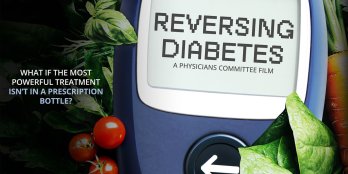
Image: Physicians Committee.
New Documentary "Reversing Diabetes" Shows How Plant-Based Eating Helps People Take Back Control
The Physicians Committee film, with Dr. Neal Barnard, Dr. Dean Ornish and Dr. Kim Williams, premiered November 10 and is now streaming
"Reversing Diabetes," a new feature documentary from the Physicians Committee for Responsible Medicine, is now streaming. The 56-minute film premiered on Tuesday, November 10, 2026, and is available to rent or buy on Amazon Prime Video, Apple TV, Fandango and Google Play.
The film follows people with type 2 diabetes who were told their condition would only get worse, until changing what they ate changed their health. Nearly a dozen experts explain the science, including Physicians Committee president Dr. Neal Barnard, Dr. Dean Ornish, Dr. Kim Williams, past president of the American College of Cardiology, and Dr. Kitt Petersen, professor of endocrinology at the Yale School of Medicine.
The CDC estimates 40.1 million Americans, 12% of the population, had diabetes in 2023, diagnosed or not.
One of the people in the film is Marc Ramirez, diagnosed with type 2 diabetes in 2002, who thought his genes were to blame:
I tried to count carbs, count calories, portion control, exercise more, eat less. Nothing really worked. I wasn't able to eliminate my medications. I was still sick.
Within months of changing his diet, Ramirez reversed his diabetes and was able to stop his medications. Stephanie Goettge, Andrew Storck and Donna Jackson share their own stories, and David Marsh, who has type 1 diabetes, explains how he reduced the amount of insulin he needed.
"What's missing from typical diabetes treatment is addressing the cause of the disease," says Dr. Barnard.
The science behind it
The film is grounded in decades of research. In Dr. Barnard's 2006 randomized trial in Diabetes Care, 99 people with type 2 diabetes followed either a low-fat vegan diet or American Diabetes Association guidelines for 22 weeks. 43% of the vegan group cut their diabetes medications, compared with 26% of the other group. Among those whose medications stayed the same, HbA1c (average blood sugar over about three months) fell 1.23 points versus 0.38, and the vegan group lost 6.5kg (14lb) against 3.1kg (7lb).
Over the full 74 weeks, allowing for medication changes, the vegan diet still came out ahead. Dr. Petersen's Yale research shows why weight loss helps: fat building up inside the liver is tied to insulin resistance there. In one small study of eight people with type 2 diabetes, losing about 8kg (18lb) on a very-low-fat diet cut liver fat by 81% and brought fasting blood sugar back to normal.
So what does "reversing" mean? An American Diabetes Association expert group calls it remission: HbA1c below 6.5% at least three months after stopping glucose-lowering medication. It isn't a cure, and people in remission stay under medical care. Type 1 diabetes doesn't go away, but in a small trial a vegan diet lowered insulin needs.
It's the latest chapter in a story we've followed for years. In 2017 we explained how a plant-based diet can prevent, treat and reverse diabetes. Since then a whole-food plant-based diet helped nearly two-thirds of type 2 diabetics cut their medication, a vegan diet cut insulin costs in people with type 1 diabetes, and in October a low-fat vegan diet cut liver fat by a third. Just this week a study in a CDC journal linked plant-forward eating to 28% lower odds of diabetes.
This article is for information only and is not medical advice. If you take medication for diabetes, do not stop or change it on your own: talk to your doctor before changing your diet, since doses may need adjusting as your blood sugar improves.
Grab some popcorn (and a bowl of beans).
Subscribe!

Love this content?
Receive our awesome newsletter straight to your Inbox!
More articles you may enjoy






Love this content?
Receive our awesome newsletter straight to your Inbox!





Comments