

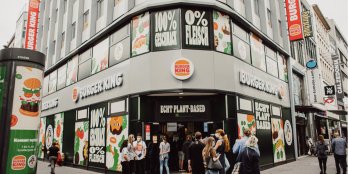
Photo: Dmitry Tonkonog via Wikimedia Commons, CC BY-SA 3.0, cropped. This adapted image is also licensed CC BY-SA 3.0.
Cambridge Students' Union Votes to Push for 75% Plant-Based Food in University Catering
The Cambridge Students' Union will lobby the university to make at least three in four food items fully plant-based
The University of Cambridge's students' union has voted to push for plant-based food to become the norm in the university's own cafes. On Monday, November 16, the Cambridge Students' Union (SU) Student Council voted 11 to 4, with one abstention, to campaign for at least 75% plant-based food across the university's central catering outlets, Varsity reports.
In Britain, a students' union is the elected, student-run organization that represents a university's students and speaks for them to the university. Its Student Council is the SU's decision-making body.
The target is specific. At least three out of every four items should be fully plant-based, with a focus on main meals. The council resolved to lobby the University Catering Service and the Estates Department to adopt that minimum of 75%, and to push for an even greater share of plant-based options once the threshold is reached or if demand is high.
An SU spokesperson told Varsity:
The Student Council voted in favour of adopting a policy for the SU to campaign for provision of 75% plant based food across central university catering outlets. This falls in line with our concern with climate change and ecological crises.
The vote commits the union to campaign for the change. It is not yet university policy, and what the cafes serve is decided by the university. It also covers central catering rather than the colleges. Cambridge students live, eat and socialize in one of the 31 autonomous colleges, which run their own kitchens and dining halls, while the University Catering Service runs the cafes and event catering used by staff, students and visitors across university sites.
That service has a head start. Under a Sustainable Food Policy introduced in 2016, it took beef and lamb off its menus and set out "to promote the consumption of plant-based foods." The council also noted that university students are around twice as likely as the wider UK population to eat a partly or fully plant-based diet, and said more plant-based food would "help provide variety and balance for those that already follow a plant based diet and encourage them to utilise University catering."
The campaign is led by SU Vice President Talulla Harris alongside the student group Plant Based Cambridge. The SU says it hopes students will have a say in the university's sustainable food research and in the policy that follows, which is due to be announced later this academic year.
Why does it matter? The SU pointed to a 2023 Oxford study in Nature Food that linked the diets of 55,504 people in the UK to data from 570 life-cycle assessments. The dietary impacts of vegans were just 25.1% of those of high meat-eaters (people eating at least 100 grams, about 3.5 ounces, of meat a day) for greenhouse gas emissions and land use, and 46.4% for water use. In other words, vegan diets had about three quarters lower greenhouse gas emissions than diets high in meat.
Cambridge is in good company. Earlier this month, students at the University of Bern in Switzerland voted two to one for fully plant-based canteens, and the University of Southampton's students voted to make plant-based the default in their union's cafes and bars. In London, King's College London topped a new UK ranking for making plant-based food the easy choice.
Students at one of the world's most famous universities want plant-based food to be the norm, and they are making their case.
Subscribe!

Love this content?
Receive our awesome newsletter straight to your Inbox!
More in News











Love this content?
Receive our awesome newsletter straight to your Inbox!













Comments