
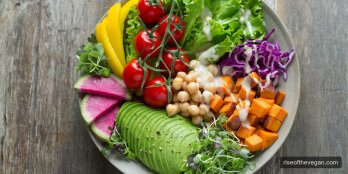
Photo: Anna Pelzer on Unsplash.
7 Scientifically Beneficial Reasons To Be Vegan
From your heart to your waistline to the planet, the research keeps stacking up
Still on the fence about going vegan? You don't have to take our word for it. Researchers at Stanford, Oxford and Harvard have spent years testing what happens when people swap animal products for plants, and the results keep pointing the same way.
Here are seven reasons to make the switch, every one of them backed by published research.
#1: It's healthier
Stanford Medicine took 22 pairs of identical twins and put one twin from each pair on a healthy vegan diet and the other on a healthy omnivore diet for eight weeks. The vegan twins saw their LDL cholesterol fall from 110.7 to 95.5 mg/dL, their fasting insulin drop by about 20%, and lost an average of 4.2lb more than their siblings.[1] Same genes, different plates.
The Academy of Nutrition and Dietetics reached its verdict years ago:
"It is the position of the Academy of Nutrition and Dietetics that appropriately planned vegetarian, including vegan, diets are healthful, nutritionally adequate, and may provide health benefits for the prevention and treatment of certain diseases. These diets are appropriate for all stages of the life cycle, including pregnancy, lactation, infancy, childhood, adolescence, older adulthood, and for athletes."[2]
#2: It's better for the planet
Oxford researchers matched the real diets of more than 55,000 people in the UK with data from over 38,000 farms. Compared with high meat eaters, vegans caused 75% less greenhouse gas emissions and land use, 73% less water pollution, 66% less biodiversity loss and 54% less water use.[3] Lead author Professor Peter Scarborough said:
Our dietary choices have a big impact on the planet. Cherry-picking data on high impact plant-based food or low impact meat can obscure the clear relationship between animal-based foods and the environment.
#3: You could live longer
A study of 73,308 Seventh-day Adventists in North America, published in JAMA Internal Medicine, found vegetarians, vegans included, had a 12% lower risk of death than non-vegetarians.[4]
And it's never too late. A modeling study in PLOS Medicine estimated that a 20-year-old American man who switches from a typical Western diet to an optimal one could gain 13 years of life, with the biggest gains coming from more legumes, whole grains and nuts, and less red and processed meat. Even at 60, the change could add around eight years.[5]
#4: You'll lose weight
In a 16-week randomised trial led by Dr. Hana Kahleova, 75 overweight adults went on either a plant-based vegan diet or a control diet. The vegan group lost 6.5 kg (14lb) more body weight and 4.3 kg more fat, and their insulin resistance improved too.[6] Lose the fat, keep the plants!
#5: It's a zero-cholesterol diet
Dietary cholesterol is only found in foods of animal origin, so on a vegan diet you eat none at all.[7] Your bloodstream notices. A European Heart Journal meta-analysis of 30 randomised trials and 2,372 people found vegetarian and vegan diets cut LDL cholesterol by about 10% and artery-clogging apolipoprotein B by 14%.[8]
#6: It's linked to a lower risk of cancer
Among 69,120 people in the Adventist Health Study, vegans had a 16% lower risk of cancer overall and a 34% lower risk of female-specific cancers.[9] Meanwhile the World Health Organization classifies processed meat as carcinogenic to humans, estimating that every 50 gram portion eaten daily raises the risk of colorectal cancer by about 18%.[10] No wonder bacon sales slumped by £123 million after that warning.
#7: It's linked to a lower risk of type 2 diabetes
Harvard researchers pooled nine studies covering 307,099 people and found those who stuck most closely to plant-based diets had a 23% lower risk of type 2 diabetes. When those diets were built on healthy plant foods, the figure rose to 30%.[11]
And before anyone asks where you'll get your protein: a randomised trial found a vegan diet builds muscle just as well as meat, and plant protein is great for building muscle too. Just remember the Academy's one firm instruction: vegans need a reliable source of vitamin B12, such as fortified foods or a supplement.
Oxford researchers have calculated that global adoption of a vegan diet could save more than 8 million lives by 2050.
It's never been easier to go vegan. Please share this article to help someone make the switch.
The evidence has never been clearer.
This article is general information and not medical advice. If you have a medical condition or take medication, speak to your doctor before making major changes to your diet.
References
1. Landry MJ, Ward CP, Cunanan KM, et al. Cardiometabolic Effects of Omnivorous vs Vegan Diets in Identical Twins: A Randomized Clinical Trial. JAMA Netw Open 2023; 6: e2344457.
2. Melina V, Craig W, Levin S. Position of the Academy of Nutrition and Dietetics: Vegetarian Diets. J Acad Nutr Diet 2016; 116: 1970-1980.
3. Scarborough P, Clark M, Cobiac L, et al. Vegans, vegetarians, fish-eaters and meat-eaters in the UK show discrepant environmental impacts. Nat Food 2023; 4: 565-574.
4. Orlich MJ, Singh PN, Sabaté J, et al. Vegetarian dietary patterns and mortality in Adventist Health Study 2. JAMA Intern Med 2013; 173: 1230-1238.
5. Fadnes LT, Økland JM, Haaland ØA, Johansson KA. Estimating impact of food choices on life expectancy: A modeling study. PLoS Med 2022; 19: e1003889.
6. Kahleova H, Fleeman R, Hlozkova A, et al. A plant-based diet in overweight individuals in a 16-week randomized clinical trial: metabolic benefits of plant protein. Nutr Diabetes 2018; 8: 58.
7. 5 Things You Should Know About Cholesterol. TIME. https://time.com/3724268/5-things-about-cholesterol
8. Koch CA, Kjeldsen EW, Frikke-Schmidt R. Vegetarian or vegan diets and blood lipids: a meta-analysis of randomized trials. Eur Heart J 2023; 44: 2609-2622.
9. Tantamango-Bartley Y, Jaceldo-Siegl K, Fan J, Fraser G. Vegetarian diets and the incidence of cancer in a low-risk population. Cancer Epidemiol Biomarkers Prev 2013; 22: 286-294.
10. International Agency for Research on Cancer (World Health Organization). Q&A on the carcinogenicity of the consumption of red meat and processed meat. https://www.iarc.who.int/wp-content/uploads/2018/11/Monographs-QA_Vol114.pdf
11. Qian F, Liu G, Hu FB, et al. Association Between Plant-Based Dietary Patterns and Risk of Type 2 Diabetes: A Systematic Review and Meta-analysis. JAMA Intern Med 2019; 179: 1335-1344.
Subscribe!
Love this content?
Receive our awesome newsletter straight to your Inbox!
More articles you may enjoy









Love this content?
Receive our awesome newsletter straight to your Inbox!








Comments